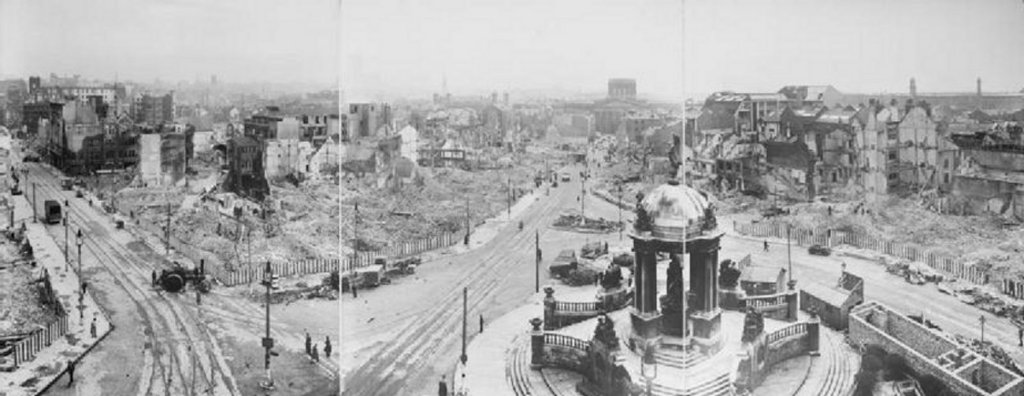
Only a short one as it’s been a while since I’ve blogged here, but I just wanted to pen some thoughts on the 75th anniversary of the May Blitz in Liverpool.
Radio Merseyside sponsored a major event at the Anglican cathedral on Tuesday 3rd; Merseyside Blitz: An Unconquered People. Written by Pauline McAdam and presented by Tony Snell and Linda McDermott, to say this was an excellent tribute to the heroes and victims of May 1941 is an understatement. It was note-perfect. Featuring music from the period, what was most powerful were the personal contributions – eyewitness testimonies (primary sources in the historian’s jargon) read aloud by actors including Craig Charles, Leanne Best, Elieen O’Brien and Aaron Kehoe. I’m a big fan of both Craig Charles and Leanne Best; Craig Charles was a hero when I was a kid, growing up watching Red Dwarf, and now his Funk and Soul show is one of the best things on the radio. I had the good fortune of seeing Leanne Best in the recent revival of Educating Rita at the Playhouse; her performance as Rita being a perfect illustration of why Willy Russell’s play should be seen on stage rather than film. The star attractions might superficially have been part of the appeal, but the power of the eyewitness stories – from firewatchers, journalists, ambulance drivers and many, many others – shone through. The actors’ considerable gifts made the stories real; from Eileen O’Brien’s excellent sardonic Scousers, arguing with ARP wardens and everyone else, to Aaron Kehoe’s interpretation of a near miss in the flight for survival.
I’ve written on how the First World War was constructed and remembered in Liverpool, and have appeared on the BBC to talk about how Liverpool and other areas dealt with it. But though the First World War is a professional interest, sparked by my studies as a teenager at school, it’s always been more remote than the Blitz. Nana Patsy – or Margaret PA-TREECIA Pinnington as she would periodically announce herself – made the war real to me as a child. Her escapades in Bootle were mesmerising; having legged it back from Southport (not literally) because she was ‘bored’, she witnessed Costigan’s warehouse aflame and searched for her cousin Mary’s teeth in the cinema as the bombs fell (or so she recalled). Many Scousers of my age – to paraphrase Frank Cottrell Boyce’s moving elegy, the ‘children of the children of the children of the Blitz’ – will no doubt have similar family stories. Of Grandad Tommy who was a cook in the army, whose soda cakes were so hard you could use them as ack ack rounds; of Grandad Finn in the Merchant Navy, out in the midst of the convoys. Of Auntie Chrissy in the Wrens, and her memories which I heard first-hand of dinner dances in Harwich. War meant lots of things to lots of different Scousers. And for me in the 1980s, reading my Commando books and watching Battle of Britain, wandering up to the warships in dock in 1993 at the 50th commemoration of the Battle of the Atlantic, it was a whole fantastical landscape.
But even in the memories replayed for children there was death. The shelters that took direct hits. Mill Road hospital. And then, in something given to me by my father, Grandad Finn’s copy of The Port at War, the Docks and Harbour Board’s attempt to chronicle what the city had gone through in wartime. It was, and remains, an excellent little book. The Malakand blast – the ammo ship that blew up – devastating part of Bootle, a town which saw 85% of its housing damaged or destroyed by the aerial raiders, was depicted in stark black-and-white in the page of the Port at War, and it left its mark on the young historian.
Mum remembered playing on the ‘debris’ (plural) as a kid, the gaps between the houses where bombs had fallen. In the ceremony at the Anglican, Frank Cottrell Boyce, some years younger than my mother, recollected avoiding those sites because of rumours of undiscovered corpses and unexploded bombs. His story was from Kirkdale, Mum’s from Bootle, but both of them ended up on the final wave of the explosion (as Cottrell Boyce described it), carried out to farther-flung parts as a result of the housing shortages which followed the war. It was Netherton for Mum and Nana Pat. And it was Winsford for Frank. The creation of (as Cottrell Boyce put it) a Scouse diaspora was another legacy of the Blitz.
There were the comical moments, not least the rendition of In My Liverpool Home, and the final rendition of Let It Be was warm and heartfelt. Near me a man cried, no doubt remembering his Nana Pat, or his Mum, or his Dad. The Blitz – not just May 1941 but as a shorthand for all the bombing of the Second World War – is a key factor in modern Scouse identity.
Pauline McAdam and her team did the memory of those who shaped that identity proud. There’ve been other excellent events in the city to commemorate the Blitz, not least the wonderful Out of the Darkness at the Bombed-Out Church on Hardman Street, where lanterns (shown also at the Anglican on Tuesday) have been laid out to represent the bombing, along with a light show on the church, itself Liverpool’s monument to the air raids and the lost.
For those who’d like to hear the stories and songs from Tuesday, you can catch the whole ceremony from the Anglican cathedral on iPlayer here at BBC Radio Merseyside.

